See the situation as it is.

You’re 30-love up on your serve. You know how to serve; you’ve done it a thousand times. Then a thought arrives: “Whatever you do, no double fault.” The ball goes into the net.
Your arm hasn’t forgotten how to serve. It’s your attention that has wandered off.
Perceiving is the way information reaches your awareness. Either it passes through the filter of your mind, or you see the situation as it is.
1The driver and their phone
On court, it’s the same. Your technique is there, and so is your experience. But if your eyes leave the ball for something else, you’re playing blind.
“Distract” comes from the Latin distrahere: to pull in several directions. Being distracted means being pulled away from your centre. And two main things pull you away from it.
2The foreground
The first is a lack of direct attention. It’s the screen you look at instead of the road.
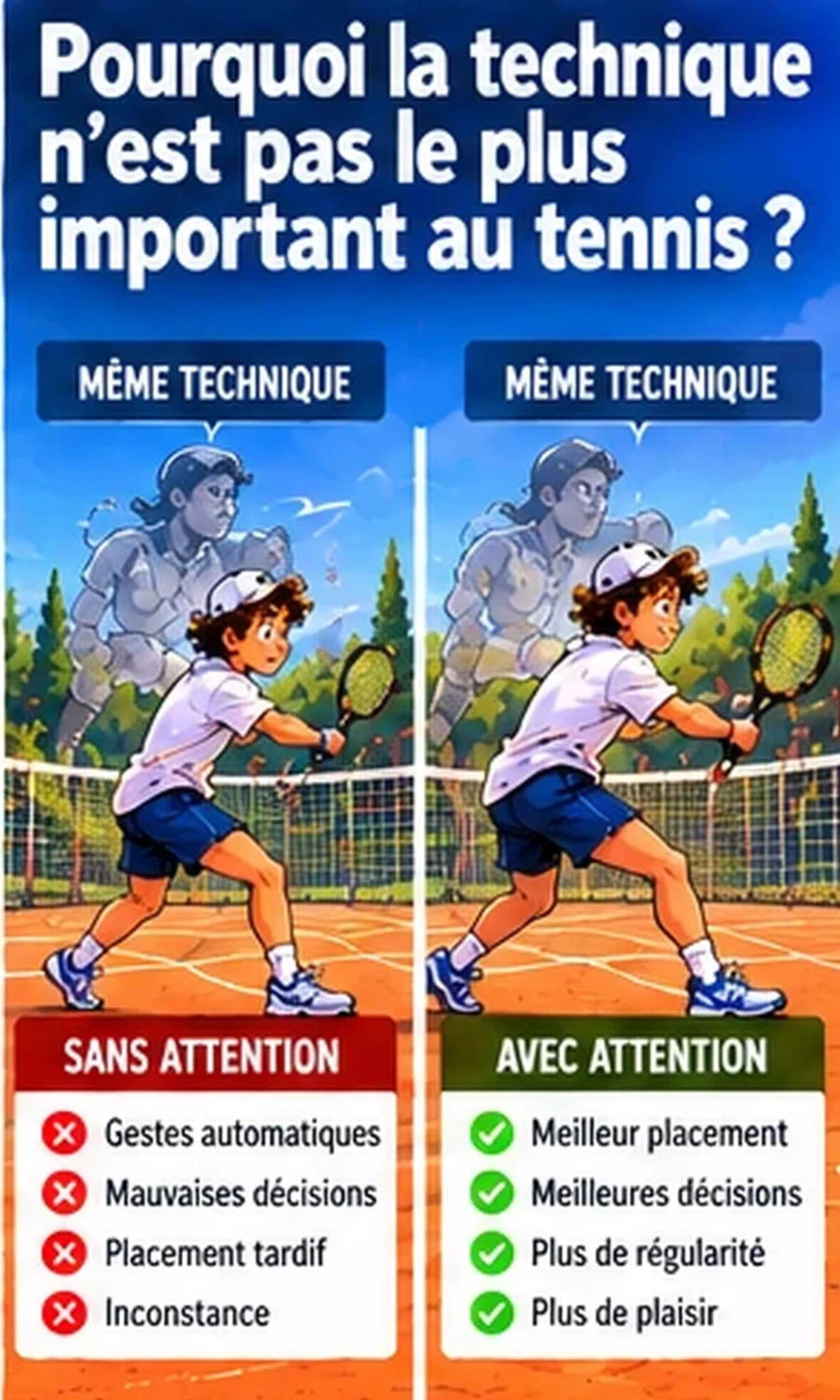
At 30-40, you look at the score, at your opponent grumbling, at the person walking past behind the fence. Meanwhile, the ball arrives, and you hit it late.
When your attention comes back to the foreground, to the ball and to what’s happening in front of you, you become available again. You see earlier, you choose more simply.
3The background
The second is more discreet: programs running in the background. Like apps running without you seeing them and draining your battery.
“I always lose these games.” “I’m useless at volleying.” So you see danger where there is none. A short ball becomes a trap, and you don’t dare come to the net, even though it was the right choice.
You shut down options, because you don’t see the situation as it is, but as you expect to see it. Spotting these programs already takes away part of their power.
Try this week
- During a game, notice each time your eyes leave the ball: the score, your opponent, the spectators.
- Between two points, note the sentence that keeps coming back to you, if there is one.
- Don’t correct anything for now: just observe.
And you, what takes your eyes off the road?
To take this further
A symbolic reading to question your habits, without treating it as a scientific explanation of your personality.
The 12 Chinese signs: another invitation to observe your game
And now, what’s your profile?
This module is for every level. The advice, though, depends on your experience and what you want. Choose your area.
The 3 tensions that sabotage your tennis
Get the free guide: 3 thirty-second tests and 3 simple exercises to play freely.
Get the free guideMore in Perception